AI Workflow Assessment: Cost, Deliverables, and When It Is Worth Doing
What a $1,500–$3,000 workflow assessment includes, how the scope is bounded, what to prepare, and when a simpler process change is enough.
Written by Abhay Rana. Updated September 13, 2026. Practical guidance and illustrative examples.
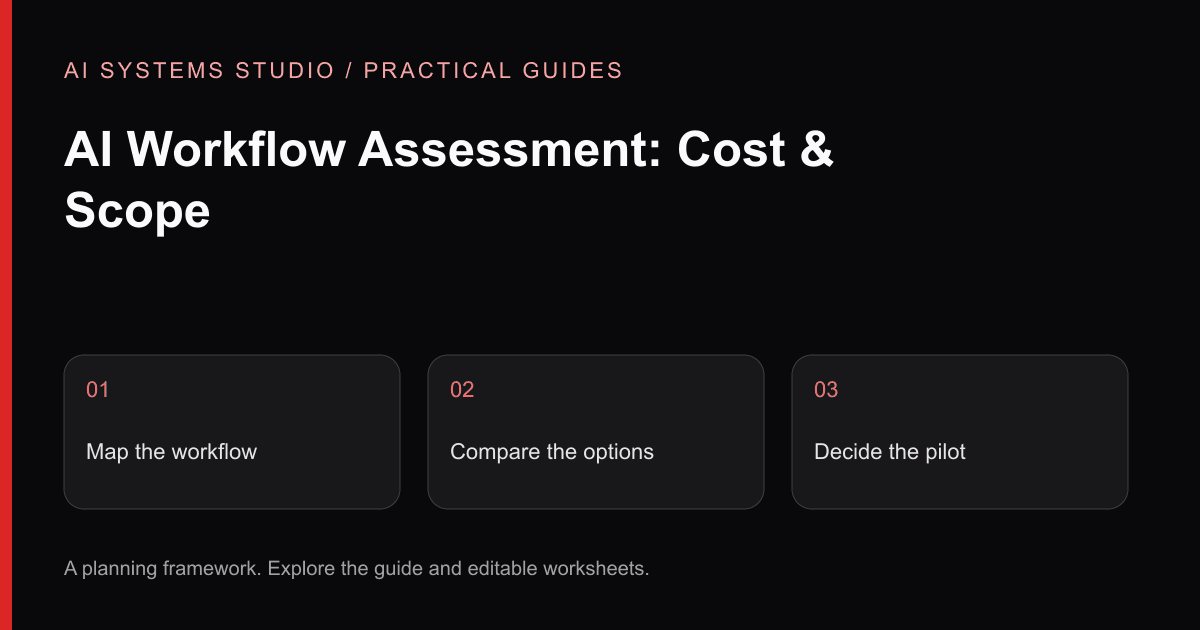
A workflow assessment should help you make a decision: build a bounded pilot, change the process first, or leave the work manual. It should explain the evidence behind that decision and what remains uncertain.
At AI Systems Studio, the current planning range is $1,500–$3,000, typically over 5–10 business days for one bounded workflow. These are planning ranges, not an automatic quote. The agreed scope, access, reviewer availability, and source complexity determine the proposal. Sending an enquiry does not purchase an assessment.
What the Assessment Includes
| Deliverable | Decision it supports |
|---|---|
| Current workflow map | Where work starts, who reviews it, and where exceptions go |
| Baseline and evaluation plan | How quality, handling effort, and failures will be measured |
| Data-flow and access review | Which sources, providers, users, and destinations are allowed |
| Options comparison | Whether process changes, rules, or model assistance fit the task |
| Risk register and controls | What could go wrong and who owns each response |
| Proposed pilot scope | What to build first, what to exclude, and when to stop |
| Handoff discussion | How the team will use the recommendation and resolve open questions |
The sample assessment shows the structure using a fictional document-intake workflow. You can read it and download the editable template without submitting an email address. It is an illustrative deliverable, not a past client report.
What It Does Not Include
The assessment does not include a complete production implementation, unrestricted integrations, a company-wide data cleanup, ongoing operations, or a guaranteed saving. A pilot is proposed separately when the evidence supports it. The assessment fee is not automatically credited against implementation unless the written agreement says so.
If your goal is a quick answer to a clearly defined software question, a full assessment may be unnecessary. If the current process has no owner or consistent rules, the most useful next step may be documenting the process before selecting AI tools.
How the Work Typically Progresses
First, agree the workflow boundary and the decision you need to make. Identify a process owner, reviewer, permitted examples, and the destination system. Confirm what may be shared and how before transferring any real documents.
Next, map the normal path and exceptions. Look at representative inputs, the current handling process, access boundaries, and available integration methods. Record gaps instead of filling them with assumptions presented as facts.
Then compare the smallest useful options. A structured form may remove the need for extraction. Rules may handle stable templates. A model-assisted step may help with varied inputs, provided that evaluation and human review are practical. The comparison should include maintenance and exception handling, not only a demo's happy path.
Finally, review the recommendation together. A useful handoff states the chosen option, exclusions, unresolved risks, acceptance checks, ownership, and conditions that would change the decision. If the answer is to wait or avoid a build, document that clearly.
What to Prepare
- One repeated workflow and a named owner.
- A plain-language description of the trigger, inputs, reviewer, and destination.
- Approximate volume and current handling effort, with the observation period.
- Representative examples you are permitted to share through an agreed channel.
- Known exceptions, sensitive-data boundaries, and integration constraints.
- The business decision and budget range the assessment should inform.
Do not put confidential files, credentials, or customer records into the website form. Start with a non-confidential description. We can agree an appropriate channel if representative material is needed later.
How to Judge Whether It Was Useful
Ask whether another person could use the assessment to understand the proposed workflow and review the build scope. Are assumptions labeled? Does each risk have an owner or control? Are the success criteria testable? Is there a no-build or stop condition? A tool list without these decisions is not enough.
For financial assumptions, use the separate ROI business-case guide. For an interaction example, try the synthetic intake workflow. Neither establishes what your actual return will be; the assessment should test that using your own baseline and constraints.
Discuss Your Workflow
Send a short enquiry. Abhay reviews it and responds within two business days with fit feedback or focused questions. A paid scope is proposed only when there is a useful, bounded assessment to do.
Related Articles
Document Intake Automation Blueprint: From Inbox to Human-Approved Action
A reference architecture for extracting, validating, reviewing, and routing document-heavy requests without giving an AI model uncontrolled authority.
How to Build an AI Workflow Automation Business Case Without Inventing ROI
A practical method for baselining a workflow, estimating value, pricing risk, and defining a pilot that can produce decision-quality evidence.
AI Agents vs Workflow Automation: What Should Your Business Build?
A practical decision guide for choosing between deterministic automation, AI-assisted workflows, and autonomous agents without overengineering the problem.
Turn the guidance into a bounded plan
Start with a workflow, representative inputs, a named reviewer, and a measurable baseline. The assessment turns that context into an implementation recommendation.